How Do You Make a Corn Maze?
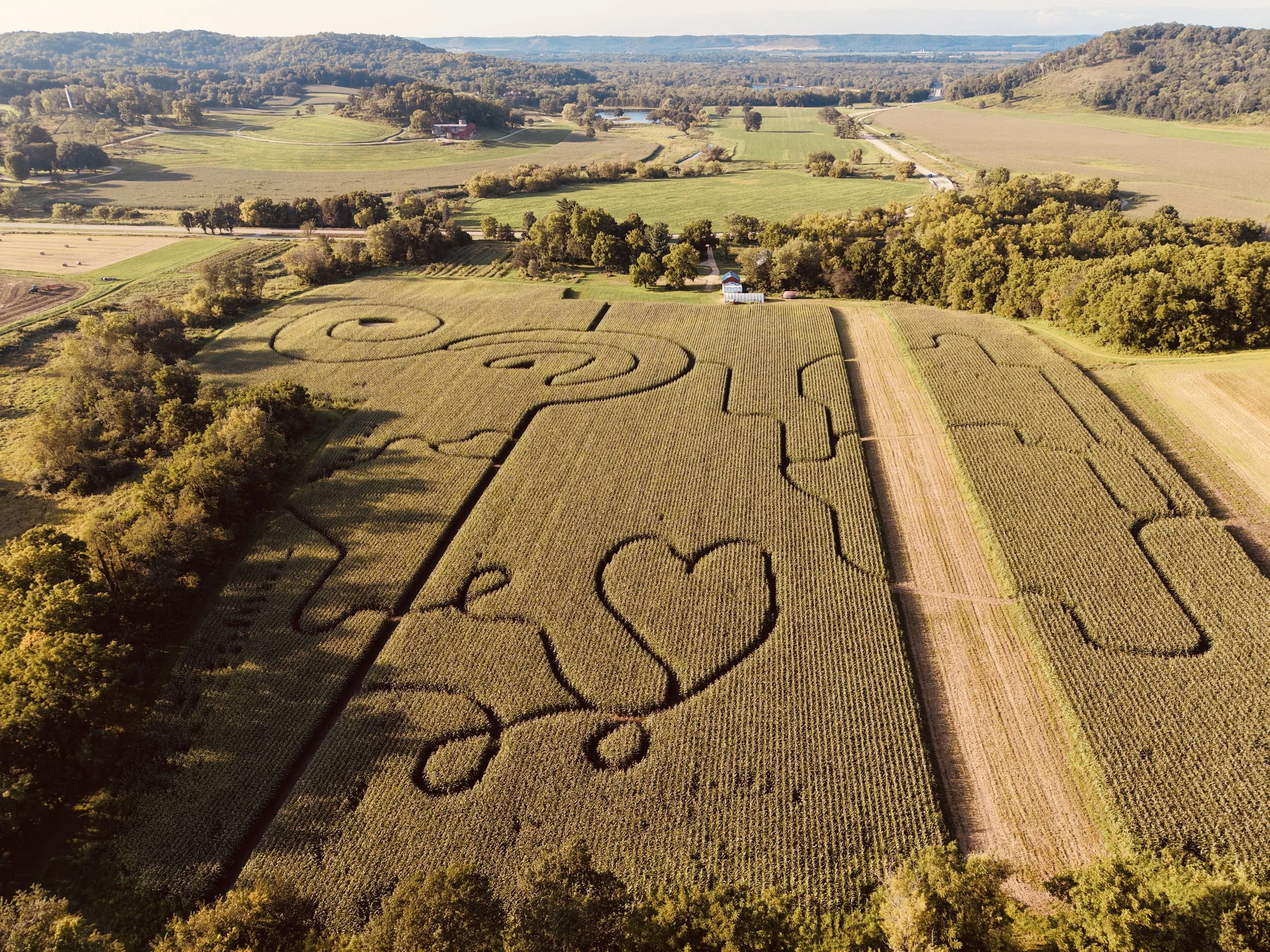
Well, do you want the way you’re supposed to do it, or the way that I did it?
The “traditional” way to make a corn maze starts with a piece of graph paper. You draw out your design in the winter, when the world is asleep and dreaming of the future. Apparently the first corn maze was carved in 1989 outside of Los Angeles, so perhaps “traditional” is not the right word, but you know how we humans are - we come up with a way that things are done, and stick to it.
In the spring, you plant out the corn field, twice, in fact, once going north-south and once going east-west, to obscure the rows and make the whole thing feel more dense. You do this conventionally, of course, with herbicide - you wouldn’t want any weeds popping up in your corn maze.
A few weeks later, when the corn is about six inches tall, you go out into the field and place flags in a grid, matching the grid intersections on your graph paper. Then begins the painstaking process of marking out the corn maze design in the field. You go out into the field with your trusty design map, and find all the points where your design touches these grid corners and mark them, perhaps with some spray paint. Then you bring out a zero turn mower and mow the pathways down, with one person on the mower and another with the map, guiding them, slowly, from marked point to marked point, until the corn has been mowed down across the whole maze.
That’s the traditional way, at least, and purists insist on it. Nowadays, you can just do the whole thing with GPS, though. Draw the design in some software program, upload it to a tractor GPS system, and, heck, the tractor can just drive itself at this point. I bet before too long you’ll be able to have a drone fly over the maze and spray the pathways out, or have a corn planter that automatically skips planting when it gets to your pathways.
I, of course, didn’t do any of that.
The field behind my house has been in corn as long as anyone can remember. It was corn when John Lloyd Jones farmed it at the turn of the century, winning the Iowa County yield contest because he “fertilized” - planting red clover in with his corn to give some extra nitrogen to the corn crop, in a time before synthetic fertilizers. It was corn when the Hoyers owned the place and rented the field out, with new-fangled “conventional” farming practices that extracted minerals, destroyed soil structure, and caused the whole farm to be so acidic that nothing but corn (and blueberries) could grow. And it was corn when Uncle Gary bought the place and converted it to organic, improved the soil health, complexified the crop rotation.
But the times, they are a-changing, here at Twin Crix, and this field won’t be corn much longer. I’ve got plans to plant it to pasture and prairie, let Michael Dolan graze his cows, let you come and collect prairie seeds, maybe have a music festival out there one of these years. The time of corn has come and, almost, gone.
So, I though, we should celebrate with a corn maze.
That’s what I was thinking, at least, when spring rolled around and Cousin Nick got ready to plant the corn one last time. I had a couple of problems, however. I wasn’t going to plant a corn field for a corn maze - I would be carving a corn maze into a corn field - and an organic one at that. Big difference.
In organic farming, you’ve got to deal with the weeds somehow. Conventional farmers have it easy - they just spray some chemicals out there and everything magically disappears. Organic farmers, farming with one hand tied behind their back, have to go old school, with mechanical cultivation of the soil. You till the soil a couple of times before you plant, to kill off early-germinating weed seeds, and then plant your corn in rows. When the corn is a few inches tall (and when I should have been carving my maze), you run through the field with a big piece of equipment that roughs up the soil in between the corn rows, killing off baby weed plants and throwing soil into the corn rows to bury weed plants there. Then, a couple weeks later, you do it again, and a couple weeks later, do it again. By the time July rolls around, the corn is knee-high - at least - and tall enough to shade out the late-germinating weed plants. You hope for the best.
In this organic corn field, I would have to wait until after this final cultivation pass to carve the maze. And it would be bumpy - real bumpy. The field starts out smooth, but each cultivation pass throws soil from between-row to in-row, so the corn rows end up being six to twelve inches higher than the furrow between. That just wouldn’t do for a walkable corn maze, and it would certainly make maze carving a slow affair.
I had been thinking about what design I wanted the maze to be, but I hadn’t written anything down until that very morning. I sketched out a couple of options - various spirals and path networks, not at all to scale - and said that was good enough.
So on a glorious July day, I took my trusty little Kubota with the bush hog mower out for a spin, into four-foot-tall standing corn, and free-handed the maze.
I knew I wanted a couple of openings in the maze, rooms for activities (as it turns out, a live music stage, a pumpkin carving zone, and a spot for a drum circle), and I wanted the paths to get up to the hilltop. I think it turned out pretty well!
It’s not a particularly intricate maze, not at all. In fact, I like to say that “there are not many decisions - and so all are consequential.” It’s more of a meditative walk through a strange environment, with twists and turns to throw you off and several dead ends and exits.
The central feature of the maze is the glyph. That’s what I call it, at least - it’s a symbol that I made up one day. I was taking in dawn on top of a sand dune along Lake Michigan some years ago, wandering in circles and talking to myself, and I grabbed a stick to draw some lines in the sand. I started to draw a P, for Patrick, then changed my mind and made it a question mark, then my mind changed itself, and I placed the dot in the center of the open circle. I stared at it with a strange mix of wonder and delight. It had all happened in the blink of an eye - I had created a personal glyph.
I’ve drawn this glyph in much sand and soil in the years since, leaving my ephemeral mark on spots that I have appreciated, signed group cards with it, and even gotten it partially tattooed on my head - though that is a story for another time.
So when the time came to carve a maze, I knew that glyph would have to be included. This Saturday, when the corn maze is open, we’ll have live music emanating across the field from the central dot of the glyph.
In a couple of weeks, the corn will be harvested. The paths will still exist, for a time, until the next re-writing of the field occurs. I said it would be pasture and prairie - and I suppose there’s no reason I can’t keep mowing some paths through the field in the years ahead. This corn maze will live on, as a prairie maze, for us to walk in the future. It won’t be quite so intimidating as a corn maze, standing tall, but as a meditative walk, perhaps it will be even better.
So come, join me, for the first ever, last ever corn maze at Twin Crix. We’ll carve some pumpkins, listen to some music, join in a drum circle, and encounter a variety of points of interest along the way.
Amazed,
Twin Crix
