The Timely Review - As You Like It, Opening Night
Let's just get it out of the way - it's a Tony Award winning performance. The Tony Award, as I understand it, is for all the years of excellence at American Players Theatre, up to and including this one. Indeed, this year's crop of plays had already been chosen, created, designed, cast, hired for, and even work begun, at that same standard of excellence, when the Tony was Awarded.
I got to hold the Tony - Sara Young was standing with the trophy, up in the stage courtyard, displaying it for giddy eyes to see. Sara reiterated that which Brenda DeVita said in the red carpet interview after the award show proper - that the town and the community, the Greater Spring Green Metropolitan Area, share in this award, for it is home, it welcomed, it welcomes still. Not every town would do so well if confronted by two hundred weirdos every year. And that kind of love, on the scale of mere thousands, is a part of why so many talented individuals are thrilled at the prospect of coming here for a summer.
Can you imagine if we were all assholes? I bet this whole APT thing wouldn't have turned out.
Sara, knowing me for a townsfolk, said as much - that it's everyone in town’s award, too, and so I asked if I could hold it and get my photo taken. Thank you, thank you for this great honor. There are too many people to thank, and so I will thank no one but everyone. I commit to continuing to do my part.
But anyway, back to the play! Great performances all around, of course, every scene vibrant and active. The staging, with the tall stairs, provided opportunities for endless tableaux of presence (phrasing inspired by Jimmy DeVita - he’s totally right). I don't know anything about how to make a play, or even all the categories which should be named in this here section of a glowing review, but Laura Rook, First-Time-Up-The-Hill director, knocks it out of the park - a lead-off homer in my homer opinion.
As the characters kept rolling in, and I saw each face I knew well or newly recognized, I started to wonder - wait a minute, who isn't in this play? All right, no Marcus and Tracy… no Brian Mani, no Jim DeVita… that’s right, I saw Colin up top, I know Patrick Budde’s not in here... But it seemed like almost half the actors are in this play, and so there are too many great roles and performances to say them all. Google the cast list and give it a round of applause at your convenience.
Instead, I want to note four characters, four roles, four actors.
First, as in the tarot, is the Fool, played by Elizabeth Ledo. I hope you got a chance to see her this winter at Two Crows’ Chesapeake, her one-human show, quick witted and sharp. I asked her afterwards if she'd ever played such a character as this Fool before. She sat back, had to think, and came to understand that the Fools she'd played had all been female, written more for poetry than for wit. But never had she played this type of stereotypically male Fool. This was, in part, unsurprising, for the aforementioned structural reasons, of which I am aware or which are implied by many other things that I believe about the world. But surprising nonetheless, for she spits them well, the witty quips, the inversions, pairings, verbal flips.
Second, David Daniel - perhaps also the second card of the tarot, the Sorcerer? He's almost a proto-Lebowski character here, lounging across the set, ever comfortable, carried by the wind. The wig is great, he wears it well, the world weary man still seized by evident delight.
Third, a new member of the Core Company, Samantha Newcomb, who was beaming, present, larger than life, swirling scenes around her. She's so confident and funny, sells the slapstick and lands each beat with winking clarity. Such a wide ranging role, and she dances across it, fleet of foot.
Fourth, a new friend, Derrick Moore. Derrick’s been helping me on the farm this summer - his “farm hand job” - and we've gotten to know each other increasingly well. So I may be biased, but from the play's first words, I thought to myself - wait a minute, Derrick is great! He's funny and earnest, ever present and evocative, lithe of legginged stride, and speaks Shakespeare to boot.
And, as I am me, I must make mention of the music. There's songs in this play, you see, the lyrics written by the bard, though the arrangement, musicianship, tenor and tone are left up to the production. It's fiddle and guitar, a drum or two, songs sung solo or in group, adding levity or somber weight to the proceedings. Elleon Dobias, skilled polyinstrumentalist, leads us into the music with gusto, and from the first notes we know we are in talented hands.
The music was composed by Andrew Hansen and directed by Camela Widad, friend of the barn, prolific singer-songwriter, skilled music teacher, and local native. I believe it was, in a way, through music in the barn that she got this job - again, we're all Tony winners here.
The scene in which David Daniels' character approaches the musicians and cajoles them to play for him makes me think, as does so much else, of the deep past, from which we have only blearily emerged. All of those years before recorded music, the centuries, the millennia, all the way back to the apes. In all that time, if we wanted to hear music, it had to be played by someone standing right before us, or by our selves. When music was immediate or not at all, the product of a particular time and place, with talent and will present, there and then, and only there and then, would we find it.
And yet, we love music. We gorge on it today, with the infinitude of recorded song available to us always. It would have been no different then, the drive, the need, for pleasing sounds and moving rhythms. And so we would have had to make it ourselves. In our heads, or to ourselves out in a field, or with the limited number of lifetime humans around us, family all, as we all are anyway, thousandth cousins or closer. If we wanted sweet song to fill our ears, it would have had to have to come from them, from us, from here, from now.
This must be a part of the point of music, an evolutionary reason for our urge towards it, that it brought us together in soon-to-be-metaphorized harmony.
And as we gorge ourselves on music from other times and other places today, I can't but help but think that we are missing out. But this is an old hobby horse of mine. Come play music in the barn if you found yourself nodding in plausible agreement.
To bring it back to the matter at hand, Elleon recently played with us in the barn, the fiddle, just a taste all told, before the Alys concert at the end of May. Elleon, let’s play more music! And the same goes for the rest of you.
I was recently listening to two people discuss a particular Shakespeare play, in which there is a dark outcome for the women in marriage. The king forces them to marry those whom they would prefer not. Personal love is defeated. The play reveals a society on the cusp, as they were in those times, of marriage for love, rather than for duty, becoming desired and expected.
I dimly wondered if the play in question was As You Like It, and held my breath throughout for the unjustness of the play’s potential ending, and was relieved - but skeptical - when all was well and ended well, by the deus ex machina of the king's change of heart. A little cheap, Shakespeare.
But where can we dream, if not for here, when, if not for now, under the stars, et cetera, et cetera, at the Tony-Award-winningly spectacular American Players Theatre. Cheers to the 2026 season. I look forward to seeing all of the plays once again this year.
In Praise of Plays,
Twin Crix
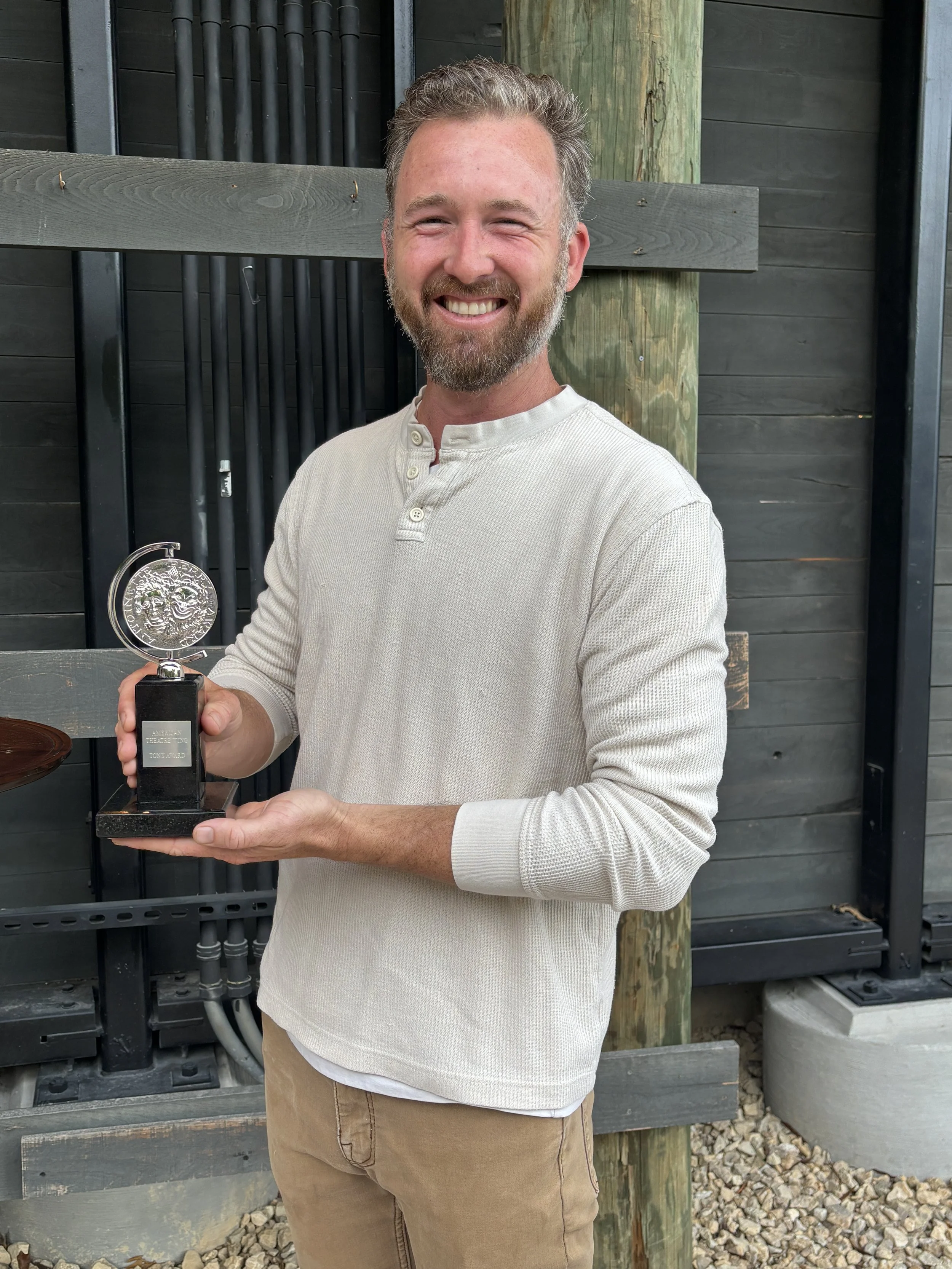
The author, awarded
