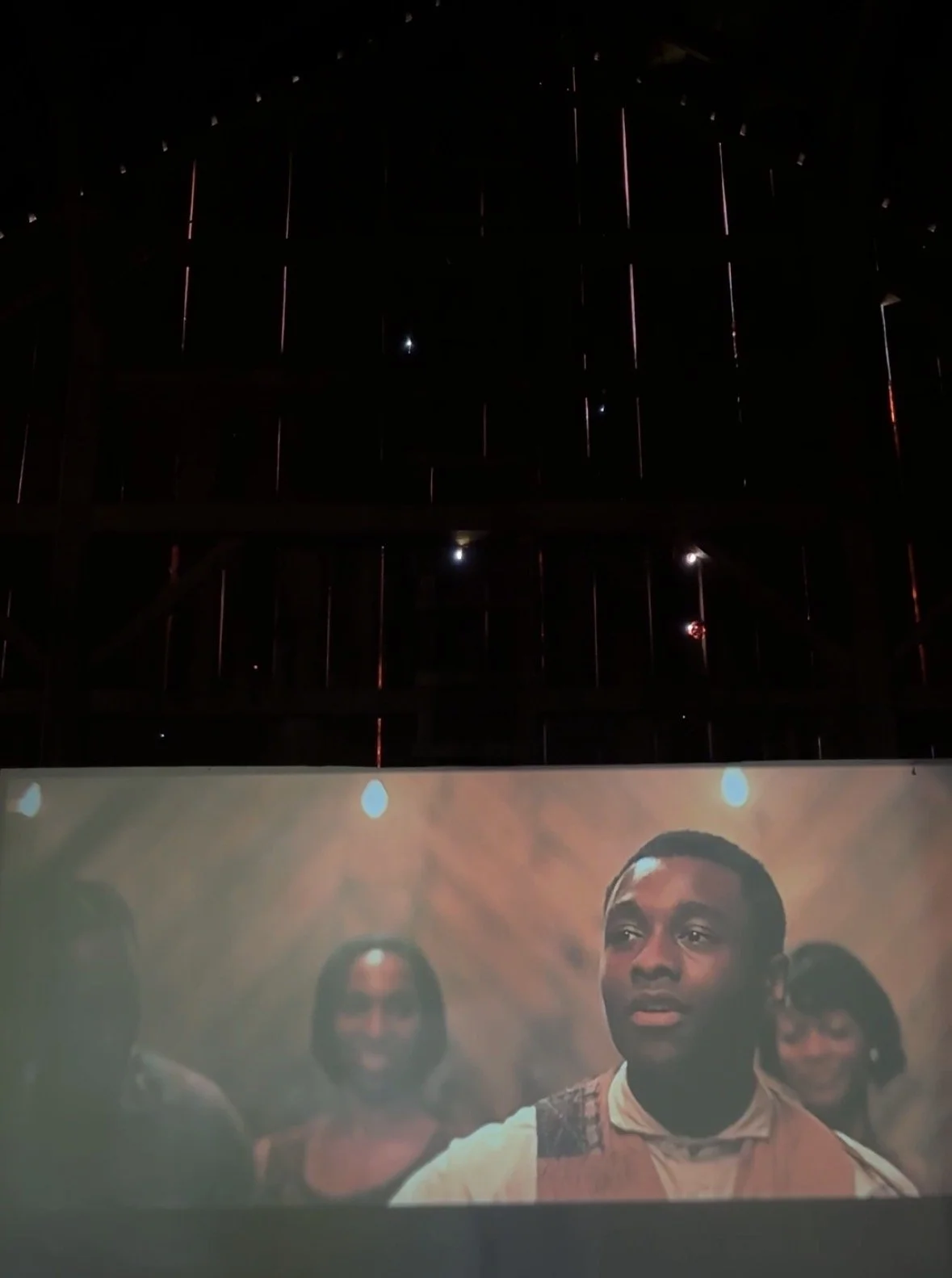
Watching Sinners, In a Barn, as a Sinner, in the Barn
What a provocative title, Sinners. Centered on sin, implying God, or Good at least. Who are these Sinners? Are we not all, in ways great and small, known and unknown?
When I first heard of Sinners, a year or more ago, the snippet of context I received was as follows: it is a Black Movie, set in a 1930s juke joint, with music, and vampires. The vampires are White. I was intrigued, and so resolved to learn as nothing-more-about-it as I could.
Sinners is a Black Movie, in that it is made by a Black Person, stars Black Actors, and is centered on the experience, real and fantastical, of Black People. But it is also a Black Movie in that it was enthusiastically dubbed so by the Hollywood establishment, that compound organism of film production, commentary, and culture. Liberals all, or most all, delighted to be seen to say “I understand this movie. I looked for, and subsequently found, the easy racial message that I knew would be there for me.”
But what different readings are there of the white vampire metaphor? If this movie is speaking to our moment, what part do I play? I am within the great tides of social and cultural, political and economical, powerful and sinful history, to be sure. But what about I, in my particularities? For there are several.
To start, I am a White Man in a White place. Each year, a number of Black Artists come to this town, and some have come to the barn, and played music, with me. So if there's a movie about Black People playing music, and being consumed by White vampires… it feels like it could be a little on the nose. A Truman Show version of reality.
I mostly never get around to watching anything. But Sinners, I resolved to watch, in the barn, when the actors and artists had returned.
And so for a year, I wondered. Am I the bad guy in this movie? Depending on the particular texture of the metaphor that this movie constructs, the answer could be yes or no. But the tragedy and triumph of a work of art is that it must choose, it has to pick a particular texture for the metaphor. It cannot represent two or ten or hundreds simultaneously, though those readings platonically exist. What readings can I ruminate myself into?
If the movie condemns me, directly or obliquely, are there other readings of the metaphor that absolve me, pathetically or completely? If the movie's frame absolves me, can I still condemn me? Am I not a sinner, condemnable by my own earnest hand? One should always wonder.
The movie in a nutshell: Twin Black Men come into some money in the city and return to open a juke joint in their small and rural Southern hometown. Music, dancing, and drinking, in Prohibition America, for and by Black People. They buy the place from a White Man, a member of the Klan. The Klan’s presence here is obligatory - in a movie made at this time, about that time, you simply can't not have the Klan be present, and though the Klan returns for a cathartic shootout in the near-final scene, they are otherwise Not The Point. Apart from the Chinese shopkeepers and one White-passing Woman with an interpersonal backstory, all of the juke joint patrons are Black People. It’s a great night, and the music is incredible, including one reality-bending dream sequence that montages over the next century of Black Music as the barn turns to flame.
Then the vampires show up.
They walk in out of the night, three White People, with banjo and fiddle and song on their lips. They request entry, are denied, and protest: “we just want universal human togetherness”. No thank you, reply the twins. They walk away, slowly - “in case you change your minds” - and sit playing the music of their own old country nearby. Some unlucky souls come outside and encounter them, are bit, and become vampires. Thus begins the action-adventure-horror hour, which is a very fun ride indeed.
At the end, the dwindling humans outlast the vampires til dawn, and the threat has passed.
The message in the vampires’ mouths - “join us, in universal human togetherness” is one that I want to agree with, that I aspire to fulfill in personal relation with my fellow humans, that some utopian part of me wishes were the words on all the world’s lips. And yet these are the bad guys!
What to make of this?
Perhaps the offer is insincere, a sly cover story for murderous consumption. But the transformed vampires are all in - they truly believe in the new ways.
Perhaps the vampire's offer is sincere, but the costs of accepting are too great.
Our protagonists feel themselves suspended between destruction by the Klan and consumption by the vampires, and reject both. Each antagonist wishes to erase them; the Klan by removing Black People from their world, the vampires by bringing Black People into a world that does not have Blackness.
In this reading, the vampires sing the praises of the Melting Pot, the siren song of the last American century. Be in America, let your distinctiveness melt away, we will all eat each other’s foods and listen to each other’s music and hear each other’s tales, all stories will be our story. Our protagonists reject this. But should they?
The vampiric act appears monstrous from the outside, inhuman, and perhaps distracts us with fear. The topsy turvy words of Jesus Christ may have seemed inhuman to his contemporaries. Love thy neighbor, love thy enemy. You, lowly sinner, have a direct and personal relationship with God.
And where is God in this movie, anyway? He is not prayed to or called out for in the action. The topic of sin hardly ever comes up, but for the bookend scenes with the preacher boy, in the aftermath of the night, bloodied, but human, returning with broken guitar to his father's church, called upon to put down the music that brought about this evil. But he does not. He rejects God's command.
Is the father right? Has his son sinned by playing music? Music has a way of moving the human soul like nothing else, it can inspire us to action, to anger, to lust, to sublime devotion. Surely the preacher does not begrudge his flock a hymn, but this music, the blues, may make you want to dance, may counsel a drink to drown out the hardships of life. The bitter end of his compatriots, subsumed into vampiricism, is earthly consequence. But earthly consequence is, famously, not God's way. A sinner may sin his whole life, and profit thereby. But fear not, O God fearers, for the punishment will come in death.
Or is the preacher wrong? For even though the music leads to calamity and challenge, the way to the Promised Land is through the Wilderness. Is this hellish scene, in fact, the work of the devil, obstructing God's will? Or a challenge laid before us by God itself?
If the vampires’ offer is sincere and achievable, it is nonetheless rejected. And so, a final dichotomy: is this wise or unwise? Should we choose distinctiveness over oneness?
Can we imagine a very different version of this metaphor, where the vampires are the good guys? Where the process of becoming a vampire is not so distractingly gruesome, but rather is pleasant, or at least unharmful, a simple touch upon the arm? Where the offer of universal human oneness is not only sincere and achievable, but also speaks to, and satisfies the fears of, these protagonists?
What would those vampires say? What arguments would come from their mouths? What fears and doubts would we hear? We have such a hard time imagining a radically different way, we cannot imagine what it would actually be like to live in utopia. But without knowing where we are going, can we nonetheless imagine how we would convince ourselves to walk there together?
Perhaps universal human oneness is too reductively simple to actually be achievable, or good. But what about universal human twoness? Each of us a pair, our distinctive self and our shared humanity, neither obliterating the other. We hold them both, in the palms of each other’s hands. What vampires would these be? How would they make their offer? Would we be wise to take it?
So when Black People come to my barn, and play music with me, feel free in a moment with me, what vampire am I? Should my apparent earnestness be viewed with healthy suspicion, if not outright mistrust? What, in fact, are my motives? How might I be using other people, these other people, for my own ends? How can I invert or subvert the vampiric metaphor, change the vampire that I am, expand the offer to include the inviolable oneness of each one, in addition to our oneness together? I do not know, I cannot know, the ends - we all will have to contribute to that. I invite you in; I do not ask to be invited.
I began this screening with a brief word. I had hoped, and in part suspected, that the most simplistic readings of the metaphors would not be there, that the author of the movie had thought ahead a step or three, and had a more uncertain and unexpected reading to impart. And so I said something, something cringeworthy, to acknowledge, with ironic sincerity, the racial narratives and realities this movie had no choice but to emerge within. “Race is a part of our world”, I sagely said, “It is a part of our world here, and it is a part of this movie. I look forward to seeing what this movie has to say.” I cringed a little bit, as I said it, a land acknowledgment, a context acknowledgment.
But is there any other way through? If we are going to hold our distinctivities together, I must hold mine, with hand outstretched. How else am I to begin but from today, as I am, vulnerable and clear?
I don’t know the answers to these questions, but I do know that Sinners was a heck of a great action movie that strummed a chord that will resonate in my head and heart. I encourage you, sinner, to see it, in a barn if possible.
Distinctively,
Twin Crix