Resurrection for Sale
Team Blue,
When I first moved to this farm, there was a lot I didn’t know. Just about all of it, in fact. I had not heard the bumps in the night, I had not seen how the snow fell and lay and drifted, I had not smelled the pungent odor of sulfur emanating from the unfiltered well water, I had not felt the sting of cold wind, I had not tasted the fruits.
The last owner, Warren Hoyer, had died. The new owner, my uncle Gary, had not set foot on the farm any more than I had. Not only did I not know the basic facts of winter and Wisconsin; I certainly did not know any of the particulars of this house.
I learned a lot, that winter, walking and watching and wondering. I learned the sound of the scurrying mouse and the well pump kicking on, saw the basement fill prodigiously with water during thaws, and learned, the hard way, where not to put shoveled snow.
And when spring came, my first spring, a vast new curriculum opened up. What are these plants, that I have seen only as the dormant living or the remnant dead? Where do the birds nest and flock? When does Cousin Nick plant the corn?
The sons of the Hoyers had communicated some information to Gary, which he relayed to me - there is an asparagus patch under that pine, you’d hate to mow it as the lawn and not know that it is there; there is an uncapped old well on the far side of the farm; things of that nature.
Their mother, Laurel Hoyer, had planted flowering bulbs along the driveway and around the house. That spring, I observed with interest and delight as they grew, unexpectedly, forthcoming blooms which I knew not. I appreciated the surprise as each new flower, whose leafy growth and developing stalk I had been noting daily, would greet me one morning in full bloom.
One such plant was first to burst forth in the spring, growing lush and green and two feet tall, but curiously never put out a flower stalk. I chalked it up to the fickle ways of Mother Nature and didn’t think much of it. As the spring turned to summer, and the flowering bulbs died back, I mowed over that area to tidy it up.
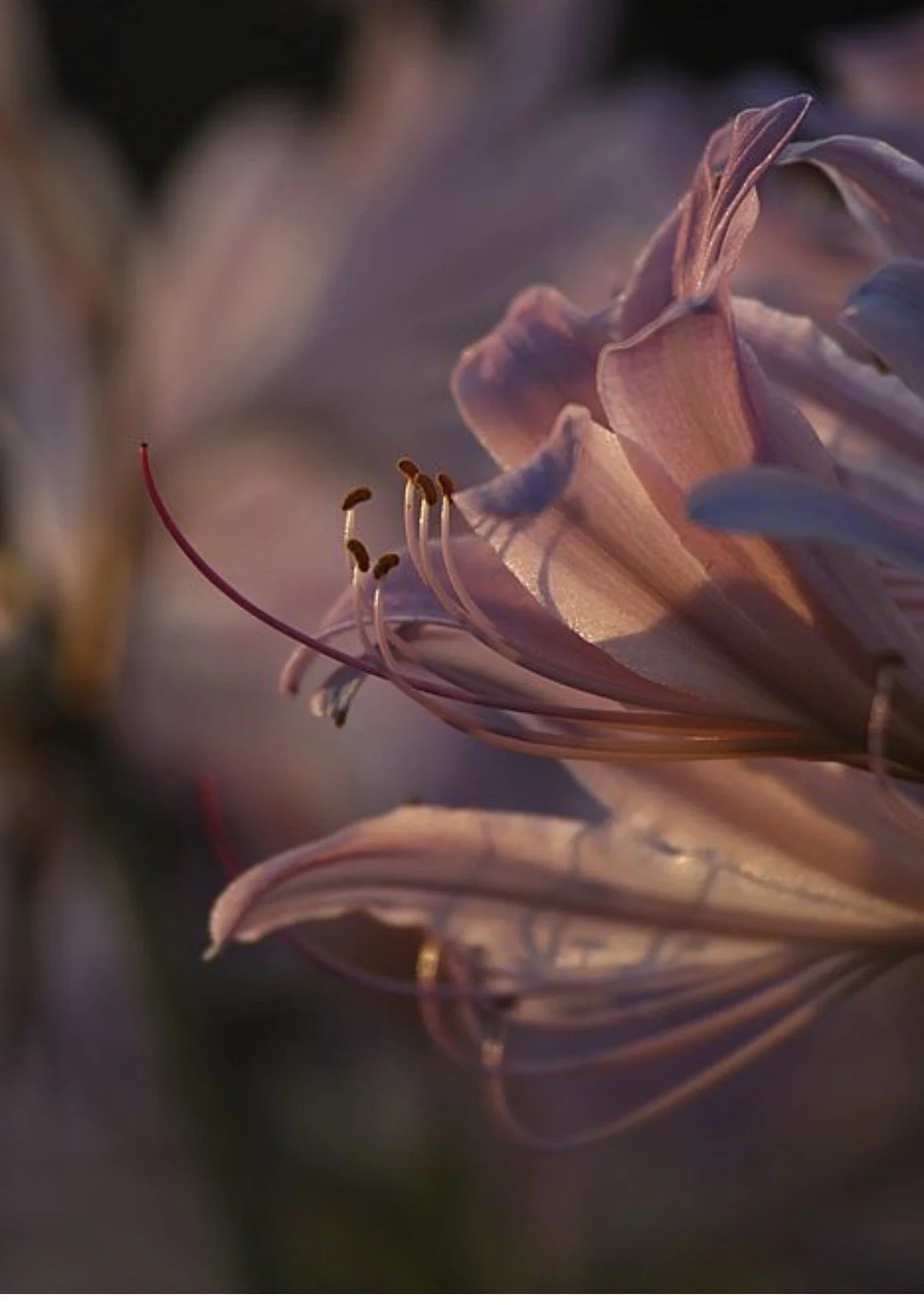
I was surprised, therefore, when suddenly, in August, flower stalks began to emerge from the grass. I was riding the mower and swerved at the last second to avoid damaging them. They shot up, within a week they were two feet tall, and one morning I awoke to unfurled pink blooms, rising out of the clean mown grass.
Some call this plant a Surprise Lily, for the unexpected bloom. Others call them Naked Ladies, for the flowering stalks that rise out of the ground without the modesty of foliage. But I prefer their third name, the Resurrection Lily.
This year, I decided to move the Resurrection Lillies. They sit awkwardly in the yard, marking a boundary that once was but no longer is. Buried alongside them is a row of bricks, flush with the ground, and I am led to believe there was at one time a short fence there. However, the flow of the barn yard has changed, the grassy area in which the Resurrection Lillies sit now wants to be a coherent whole, wants to shed its arbitrary division. Laurel Hoyer, when she planted them, was not imagining a barn yard filled with people, an oven cooking pizzas, music played in the barn. The times have changed, and the space must change with it. I dug up the Resurrection Lillies, and wondered where to plant them next.
A prominent feature of my back yard is the trunk of a White Pine, planted by the Lloyd Joneses long before the Hoyers. This tree was long dead by the time I moved here. It had snapped in half long ago, and I removed the decomposing top as I cleared the yard, but I left the towering sculptural trunk standing, thirty feet high, gnarled and twisting.
I was often reminded of a notion from the novel The Overstory, in which one character sits in protest high in a Giant Redwood as loggers clearcut its forest, preventing at least this one great tree from being felled. She asks, rhetorically, what it would cost to replicate this great tree, three hundred feet tall, ten feet or more in diameter, a cacophony of branches, brambles and mosses and ferns making their homes in a crook of a limb a hundred feet in the air. If you were to create a sculpture of this tree, exact in form and dimension, with every detail noted and reproduced, and you were to place it in Times Square as an art installation - what would it cost? Would it even be possible?
So too, with this (comparatively diminutive) pine. The sculpture has stood proud over the yard for my entire time here, a silent sentinel that remembers time that no living human can, that demonstrates the reality of those days in the exactness of its form, in the way it twirled as it grew, in the space it chose to occupy with its limbs, responding to the constraints placed upon it by nearby trees, then greater than it, who are long gone but whose prior presence echoes into the present by the impact they had on the pine.
This sculpture fell last fall. I saw that the great trunk seemed to be leaning more than I recalled, the rain and wind were finally getting to it, and on a blustery day I peeked out the window and was stunned to see it on the ground. I did not see it fall, it did not make a sound.
I knew immediately that I would leave it as it lay. This new configuration had been in the works for a century, since that pine first grew, and greatened, and died, and decayed, and fell to the prevailing winds. Who am I to move it? Who am I to say that this slow-motion necessity does not deserve to see itself through? I will let it sit, and crumble, be eaten by bugs and by fungus, I will let it sink into the earth exactly where it always knew it would lay. How long will it take? Will I be alive to see the end of this process? Will there be an end?
And so, as I dug up the Resurrection Lillies and wondered where to place them, it became clear that they should be planted near this old pine. They surround it now, lush foliage without a hint of flower.
In the meantime, I have way more bulbs than I need. I had never tended to Laurel Hoyer’s flowers like she would have, had never split them. The patch of Resurrection Lillies had grown dense and crowded. I replanted a portion near the pine; I offer the rest to you.
Resurrection for Sale, $10, for a limited time only.
I’ll be at the Farmer’s Market a couple of Saturdays this spring, and will have a plant sale on Mother’s Day.
Beware, though, that the Resurrection Lily will likely not resurrect the first year after planting. They need a year in the ground to grow comfortable, to know their place, before they flower. You’ll just have to trust me that the resurrection is coming.
Come back,
Twin Crix
